
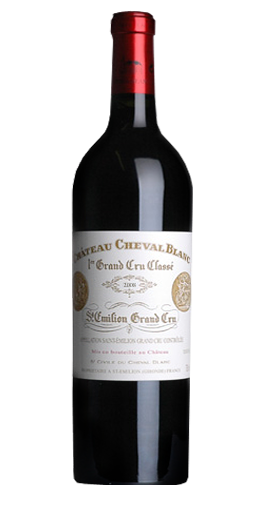
Château Cheval Blanc 2008 - 1er Grand Cru Classé
Ratings: Robert Parker 95–97/100, RVF 18.5/20, Bettane & Desseauve 18.5/20, Gault Millau 16.5/20, Wine Spectator 93/100, IWC 91-94/100, Jean-Marc Quarin 94/100, Jancis Robinson 17/20, Decanter 5*
“The 2008 is a complete, classic Cheval, endowed with great precision; it is the most interesting vintage produced for this estate in 10 years.” (Les Meilleurs Vins de France 2011 - RVF)
Buy your Cheval Blanc wines at the best price in a private sale!
Starting at €99 on your first order
Eye
deep purple dress
Nose
rich and complex, with beautiful fruitiness
Palate
powerful and refined, full of elegance and aromatic subtlety
Serve
decant at 16-17°C
Open
1 hour ago
Drink from
2011
Drink before
2028

Food and wine pairings
A déguster sur une viande rouge, des gibiers, un plateau de fromages...<br/>


Bettane & Desseauve
Rated (2021 Guide) 5*Stars (Exceptional producers who represent the absolute pinnacle of quality in France and around the world)
About the estate:
With apple trees growing among the vines, along with chickens, sheep, and a few pigs, Cheval Blanc embraces a sustainable approach to agriculture. These are all assets for the 39 hectares of this legendary estate, which occupies a prime location on the appellation’s sandy-gravel plateau—slightly clayier on its northern slope, toward Pomerol. Cheval Blanc stands out from its neighbors for its legendary longevity, thanks to the high percentage of Cabernet Franc. Pierre Lurton, its director since 1991 (he also presides over Château d’Yquem), and his talented teams demonstrate rigor and ingenuity in perpetuating its inimitable style. The 2018, 2019, and 2020 vintages are superb.

Guide Hachette des vins
Rated estate (2016 guide) Award-winning wines (This producer’s wines regularly receive awards from the guide)
About the estate:
Originally a simple farmstead in Figeac, Cheval Blanc became an independent estate in 1832 when Jean-Jacques Ducasse, president of the Libourne court, purchased it and had the current château built. His descendants undertook major improvements, particularly drainage work, and by the end of the Second Empire, the estate had reached its current size (37 hectares) and was ranked among the most renowned in Saint-Émilion. Its terroir, of the Pomerol type with ancient gravel and sand over clay, explains the uniqueness of its vineyard composition, dominated by Cabernet Franc and complemented by Merlot. The descendants of President Ducasse remained at the helm of the estate until its acquisition in 1998 by Bernard Arnault (LVMH) and Albert Frère. They appointed Pierre Lurton as general manager and provided the château with a new cellar, designed by Christian de Portzamparc.

Robert Parker - Wine Advocate
Estate rated "Recommended" (Wine producer recommended by Robert Parker - The Wine Advocate)
About the estate:

RVF - La Revue du Vin de France / Guide des Meilleurs Vins de France
Rated estate (2016 guide): 3 stars (These represent the pinnacle of French winemaking. The finest terroirs cultivated by the greatest winemakers. Tasting their wine is always a magical experience)
About the estate:
Against a backdrop of intensifying competition among the First Growths, and following a period of neglect (up until 2005), the return of the estate owned by businessmen Albert Frère and Bernard Arnaud to the Saint-Émilion elite has been nothing short of spectacular. A new chapter is being written on this exceptional sandy-gravel terroir on the edge of Pomerol, with a vineyard that relies heavily on Cabernet Franc—including 8 hectares planted in 1956—which gives the grand vin a unique freshness and depth of flavor. Since 2011, winemaking has taken place in the new, airy winery designed by architect Christian de Portzamparc. A tall, vast, luminous, minimalist, and eco-friendly structure. Fifty-five custom-made ivory-colored cement vats, reinforced and contoured. The “beautiful and useful” facility that Captain-Director Pierre Lurton and Technical Director Pierre-Olivier Clouet had dreamed of. This spectacular yet unostentatious investment follows a vigorous overhaul of viticulture since 2008. With its confirmation as a First Growth in the 2012 classification, the estate’s footprint has expanded. For the first time, 1.40 hectares from the annexation of Château Tour du Pin (a clay hill directly extending from the château’s driveway) are included in the grand cru. Though never the most powerful, Cheval Blanc nevertheless proves capable of offering rare elegance and refinement. These characteristics are evident in the last five vintages and justify Cheval Blanc’s return last year to the exclusive three-star club.
Discover more wines from the estate