
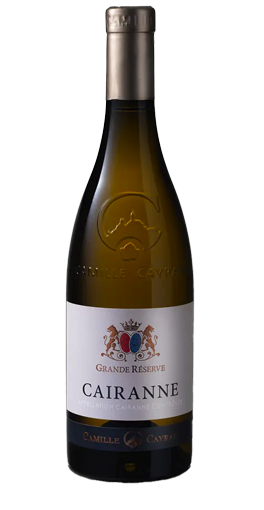
Camille Cayran - Cairanne Grande Réserve blanc 2024

90/100
RVF
"The white wine to have on hand this summer!"
Like its red counterpart, this cuvée benefits from the lovely terroir of Cairanne. A white wine with a straw-yellow color and green highlights. It opens with a floral nose, followed by notes of white fruit. After a fresh attack, floral and honeyed notes take center stage, and the finish is round with lovely lingering aromas.
Buy your Cave de Cairanne wines at the best price through a private sale!
Starting at €99 on your first order
Eye
Straw-yellow color with green highlights
Nose
Floral, followed by notes of white-fleshed fruit (peach)
Palate
After the fresh opening, floral and honeyed notes take center stage; the finish is smooth and well-rounded, with lovely lingering aromas.
Serve
At 12°C
Open
1/2 front
Drink before
2028

Food and Wine Pairings
Enjoy it with a green salad with warm goat cheese, grilled sea bass with fennel, a brandade parmentier, or cod accras...


Decanter
Rated winery (2024 guide) Recommended

Guide Hachette des vins
Rated Estate (2024 Guide) Award-Winning Wines (This producer's wines regularly receive awards from the guide)
About the estate:
Founded in 1929, the Cairanne cooperative is a major player in the region with its two flagship brands: Camille Cayran for the traditional retail market and Victor Delauze for mass-market retailers. In 2020, it merged with the Cave de Sainte Cécile-les-Vignes to become Cave de Cairanne Camille & Cécilia. It now manages more than 1,100 hectares and has expanded its product line to include an organic range.

RVF - La Revue du Vin de France / Guide des Meilleurs Vins de France
Wine rated (2026 guide) 90/100
Award-Winning Estate (2024 Guide) Cooperative Winery of the Year (RVF Grand Prix for Cooperative Winery of the Year)
About the estate:
Founded in 1929 in the southern Rhône Valley, the Cairanne cooperative is a model of success. It encompasses 330 hectares, cultivated by fifty-five cooperative members, yielding a production of 13,000 hectoliters of wine. In 2014, however, it was selling off its production at rock-bottom prices to big-box retailers, while carrying a debt of 8 million euros.
To get this “old lady” back on her feet, the winery hired Denis Crespo as director in 2015. With his intimate knowledge of vineyards and wine, he succeeded in convincing the members that quality is the only way forward, while involving them more closely in the winemaking process. The grapes are harvested when ripe, and vineyard work is now carried out on a plot-by-plot basis. In the cellar, he brought about a revolution by vinifying the wines with minimal sulfur additions, including a few “sulfur-free” cuvées designed to enhance tannin quality.
His goal: to achieve better balance. Above all, he has completely rethought the distribution channel, moving away from large retailers in favor of short supply chains, the restaurant industry, and exports. The wines have taken a huge leap forward in quality. We commend this collective effort, which has yielded significant results both in terms of wine quality and the long-term sustainability of the winemakers.

Jancis Robinson
Rated winery (2023 guide) Recommended

James Suckling
Rated Estate (2024 Guide) Recommended
Customer Rating

5/5
based on 1 review
Review by Mr. JEAN MARIE B. Published on September 14, 2026
See all reviews from this customer
Discover more wines from the estate
