
21597 customer reviews
Lussac-Saint-Emilion


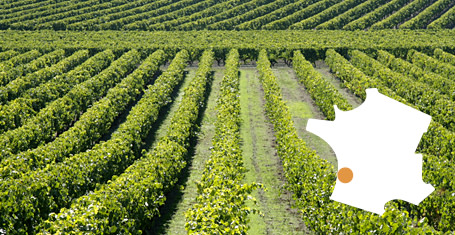
The Lussac-Saint-Émilion vineyard has been protected by an Appellation d’Origine Contrôlée (AOC) since November 14, 1936. Only wines harvested within the municipality of Lussac are eligible for the Lussac-Saint-Émilion AOC. The Lussac-Saint-Émilion vineyard thus covers an area of more than 1,440 hectares north of the Saint-Émilion hill, with an annual production of nearly 70,000 hectoliters.
The Lussac-Saint-Emilion region enjoys a microclimate favorable to grapevines, with moderate rainfall and warm temperatures in the summer. The vineyards are planted on soils that are primarily clay-limestone. In Lussac, the vineyards are terraced from the valleys up to the plateaus, forming a south-facing amphitheater. This layout promotes natural drainage.
The blend of Lussac-Saint-Emilion wines is dominated by Merlot combined with Cabernet Franc. Lussac-Saint-Emilion wines express rich and intense aromas, with notes of red fruits (strawberry, raspberry, cherry), supported by hints of licorice, leather, prune, and spices. As they age, they develop tertiary aromas, notably of game. On the palate, they are elegant and full-bodied, velvety, and generous, with power and complexity, much like the Lussac-Saint-Émilion wine offered by Château Bellevue.
Lussac-Saint-Emilion: A History, A Wine
Also known as the “satellite of Saint-Émilion,” Lussac-Saint-Émilion’s geographical location tells its story. And the true artistry of Lussac-Saint-Émilion’s winemakers lies in their skillful blend of tradition and innovation—a combination that has earned the Saint-Émilion vineyards their worldwide reputation.
Lussac-Saint-Emilion the Ancient
The Libourne region has been inhabited since time immemorial. Located along the trade routes between Brittany and Languedoc, Bordeaux and its surrounding region were invaded by the Romans, led by their lieutenant Publius Crassus. The first grapevines in Lussac-Saint-Emilion were brought by the Gallo-Roman figure Luccius and planted around his villa, Luccianus. Lussac owes its name to this figure.
After being completely destroyed by the barbarian invasions, Lussac rose from the ashes with the arrival of Cistercian monks in the 12th century, and vineyards flourished around Villa Luccianus, turning it into a very fashionable town by the 17th century.
This small municipality, covering 1,450 hectares, is crisscrossed by 11 km of waterways.
Triptych in Sight
The formation of its subsoil over the ages has given Lussac its diversity: from the northeast come the sands and gravels of the Périgord; from the east, sandy-clay formations cover the slopes and lower parts of the hills; and from the south, asterian limestone forms a vast limestone plateau across the Libournais region.
Naturally, these soils lend themselves to these diverse grape varieties. Merlot, Cabernet Franc, and Cabernet Sauvignon make up the bulk of the grape varieties listed in the Bordeaux Lussac-Saint-Emilion appellation specifications, along with Malbec and, to a much lesser extent, Carmenère.
Merlot thrives particularly well in cool, clay-limestone soils. It is this grape that gives Lussac-Saint-Emilion its woody, spicy, and red fruit notes. It accounts for up to 80% of the grape varieties used in Lussac-Saint-Emilion.
Cabernet Franc grown in sandy-clay soils contributes tannins and aromas of raspberry and violet, resulting in a well-balanced wine.
Cabernet Sauvignon thrives in sandy-gravel soils. As a key component of grand cru wines, it lends the Bordeaux region of Lussac-Saint-Emilion its full-bodied character and notes of dark fruit.
Of youth's green days...
Depending on the vintage, Lussac-Saint-Emilion is aged for 14 to 18 months. It reaches its peak after 3 or 4 years of aging. However, Lussac-Saint-Emilion vintages from the northern plateaus are best enjoyed young.
At this stage of maturity, it pairs nicely with appetizers such as tapas, venison terrines, duck terrines, or hare terrines; and with meats such as beef ribs.
... with a robust, full-bodied character
These wines are notable for their aging potential, which ranges from 5 to 10 years depending on the vintage and vineyard.
Pair with roasted meats: roast duck, flank steak, lamb chops; a platter of cold cuts; smoked duck breast.
Exceptional vintages
While 1929, 1982, and 2005 are considered the vintages of the century, 1945, 1961, and 1990 surpass all others in quality and are considered the vintages of the millennium.
For more information, visit the website at Lussac-Saint-Emilion
Buy the best wines from Lussac-Saint-Emilion at a private sale!
Rated site21597 reviews
-20€
Starting at €99 on your first order
Discover our selection of the best wine producers in Lussac-Saint-Emilion


Loading...