
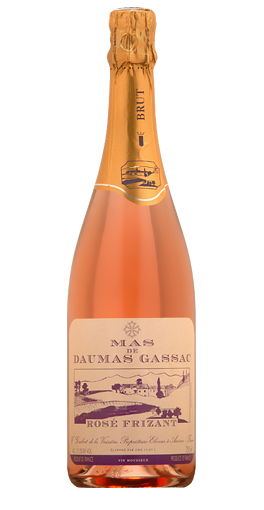

Rosé Frizant comes from the young vines of the Daumas Gassac vineyard and adds a unique touch to the estate’s lineup. A naturally sparkling wine—probably the estate’s most playful. A true rosé from the Gassac Valley that shines with the freshness of its fine bubbles. Perfect as an aperitif!
Buy your Daumas Gassac wines at the best price in a private sale!
Starting at €99 on your first order
Eye
pink dress
Nose
smoothness of the fruit aromas
Palate
It quenches your thirst, delights your palate, and lifts your spirits
Serve
at 11-12°C
Open
and serve!
Drink from
2012
Drink before
2014
Production
25,000 bottles

Food and Wine Pairings
A déguster en apéritif, pour la fraîcheur de ses fines bulles... <br/>


Bettane & Desseauve
Rated estate (2025 guide): 3*Stars (High-quality production that serves as a benchmark in its sector)
About the estate:
Much has been written about the Daumas-Gassac estate. Aimé Guibert—who passed away in 2016—had identified high-quality terroirs in Aniane suitable for growing a Cabernet Sauvignon that was not authorized by the local appellations. For his white wine, he also chose to produce a blend of Chardonnay, Viognier, and Petit Manseng, which likewise barred him from using the appellation. His estate therefore produces a red (an 80% blend of non-cloned Cabernet Sauvignon accompanied by about twenty other grape varieties, most of them rare) and a white (also a multi-varietal blend) under the Hérault IGP, which he has successfully positioned at a price point unprecedented in this category. The white is aged in stainless-steel tanks, while the red is partially aged in barrels. Both the white and red wines exhibit unparalleled purity, precision, and complexity, and age remarkably well. The lineup is rounded out by pleasant IGP wines, designed to be enjoyed young. A sure bet in the region.

Guide Hachette des vins
Rated estate (2025 guide) Award-winning wines (This producer's wines regularly receive awards from the guide)
About the estate:
A fine example of the rise of Languedoc wines across the five continents, this estate—founded in 1971 by Aimé and Véronique Guibert—caused a stir a few years ago by offering regional wines at the same price as fine Bordeaux wines. It has, however, remained at the top of its game with wines of consistent quality and remarkable aging potential. Today, this leading estate is run by the founders’ sons.

RVF - La Revue du Vin de France / Guide des Meilleurs Vins de France
Rated estate (2025 guide) 1*Star (Up-and-coming stars or high-quality winemakers producing wines of a high standard—you won’t be disappointed when you taste the wines from these estates)
About the estate:
Aimé Guibert was a leading figure in the revival of Languedoc’s wine industry and its rise to prominence first in France and then internationally, after purchasing his old farmhouse nestled along the banks of the Gassac River. He helped restore the potential of the limestone terroir of the Upper Gassac Valley—composed of glacial gravel—in the foothills of the Cévennes. The wide daily temperature range and the nature of the soils convinced him that this was a great terroir for Cabernet Sauvignon, which would be sourced from massal selections of the finest Bordeaux châteaux. Aimé’s sons—Samuel, Gaël, Roman, and Basile—now steer the estate’s destiny. Daumas Gassac has distinguished itself through its potential and longevity. Like the world’s great Cabernet Sauvignons, it is best enjoyed after at least a decade. While the estate’s legacy is immense and undeniable—and the quality of the reds is consistently high (even if the wines do not necessarily reflect the terroir)—we expect much more from the entire range.
Customer Rating

3.1/5
based on 12 reviews
Review by Mr. ANTOINE S. Published on January 19, 2014
Very decent and great value for the price at 9.00
See all reviews from this customer
Review and rating by Mr. JEAN M. Posted on February 28, 2020
See all reviews from this customer
Review by Mr. JEAN CLAUDE A. Posted on November 16, 2019
See all reviews from this customer
Review by Mr. FRANCK F. Published on January 16, 2019
See all reviews from this customer
Review and comment by Mr. DANIEL T. Posted on May 4, 2018
See all reviews from this customer
Review by Mr. ADRIEN A. Published on April 22, 2018
See all reviews from this customer
Review by Mr. ALAIN D. Published on February 26, 2015
See all reviews from this customer
Review by Mr. JEAN CHRISTOPHE L. Published on December 17, 2013
See all reviews from this customer
Review and opinion by Mr. RENAUD E. Published on June 23, 2013
See all reviews from this customer
Review by Mr. JEAN NOEL R. Published on 12/19/2012
See all reviews from this customer
Discover more wines from the estate


