
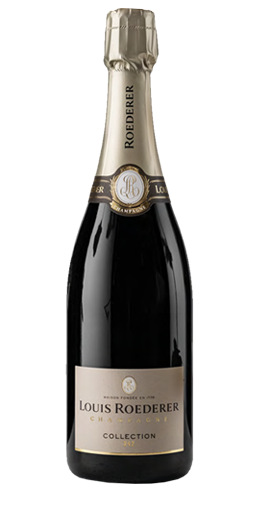
Champagne Louis Roederer - Collection 242 Brut


93+/100
Robert Parker
93/100
RVF
"New style!"
The "Brut Premier" cuvée has been reimagined, offering greater complexity and precision. Collection 242 represents the House’s 242nd blend since its founding. Based on the 2017 vintage (56%), this cuvée is complemented by 34% reserve wine drawn from the Perpetual Reserve established in 2012 and 10% aged in oak. This turning point marks a new chapter in the history of this great Champagne House as it seeks freedom and a more contemporary style!
Buy your Louis Roederer Champagnes at the best price in a private sale!
Starting at €99 on your first order
Nose
Notes of white fruit, citrus zest, and acacia blossom. After aeration, a subtle hint of toasted hazelnut—the signature aroma of Chardonnay.
Palate
A slender, very pure structure. Freshness, precision, finesse, and complex, well-defined flavors. The finish features a very pleasant briny note.
Serve
At 8-10°C
Drink before
2025

Food and Wine Pairings
It pairs equally well on its own as an aperitif or with a seafood platter, lobster, crayfish fricassee, or a selection of cheeses such as Brillat-Savarin or Chaource...


Bettane & Desseauve
Rated estate (2026 guide): 5*Stars (Exceptional producers who represent the absolute pinnacle of quality in France and around the world)
About the estate:
Founded in Reims in 1776, Roederer is still owned by the same family, represented today by Frédéric Rouzaud. In recent years, the estate has been a pioneer, being the first to gradually convert its vast 242-hectare vineyard to organic and biodynamic farming (126 hectares). Jean-Baptiste Lecaillon, a renowned cellar master and agronomist, never ceases to impress with his intimate knowledge of every plot on the estate and the decisions he makes. “Cristal,” an exceptional prestige cuvée, comes exclusively from vines growing on chalky soils. The vintage wines and the core of the non-vintage brut—now called “Collection,” with a number indicating the base year of the blend—come from soils that are still calcareous but contain more clay. Wines intended for extended aging do not undergo malolactic fermentation, which requires harvesting the grapes at high ripeness—often close to 11°. The current wines are certainly the most remarkable ever produced, including the astonishing red and white Coteaux-Champenois, along with the highly exclusive Camille cuvées.

Guide Hachette des vins
Rated Estate: Award-Winning Wines (This producer’s wines regularly receive awards from the guide)
About the estate:
A house founded in Reims as early as 1776. Louis Roederer became its owner in 1833, expanded the business, and acquired vineyards. In the 1870s, the house—which produced 2.5 million bottles—had Russia as its primary customer, where Tsar Alexander II asked Louis Roederer to create a prestigious champagne for him: the famous Cristal cuvée was launched in 1876. With a vineyard of 240 hectares (comprising Premier Cru and Grand Cru plots) accounting for two-thirds of its supply, the company is still run by the founders’ descendants. The most recent, Frédéric Rouzaud, now heads a group that owns Deutz Champagnes and numerous prestigious wines, from the Médoc to Provence, and from Portugal to California.

Robert Parker - Wine Advocate
Wine rated (2021 guide) 93+/100 (Outstanding wine)
Estate rated "Recommended" (Wine producer recommended by Robert Parker—The Wine Advocate)
About the wine:
“Roederer’s Brut Premier was created in the 1980s to prove to consumers that we could deliver consistent quality with a blend that compensated for vintages that were less than perfectly ripe,” explains Jean-Baptiste Lecaillon. “We used to blend with the goal of achieving ripeness. The concept behind the Brut Collection is the exact opposite: we seek freshness and embrace uniqueness, which we highlight by listing the year of each blend. This project has been in the works since 2012, when Lecaillon set aside 21,000 liters of wine to create a Perpetual Reserve aged in large tanks without malolactic fermentation. The sourcing process has also evolved: fewer musts come from cooperatives, and only vineyards cultivated without the use of herbicides are included in the blend. A dedicated team oversees the entire process, visiting each grower three times a year. And winemaking is done plot by plot to yield the maximum number of components for the blend. Collection 242 is based on the 2017 vintage (56%), supplemented by 34% reserve wines from the Réserve Perpétuelle established in 2012 and 10% reserve wines aged in large oak casks.

RVF - La Revue du Vin de France / Guide des Meilleurs Vins de France
Wine rated (2021 guide) 93/100
Rated estate (2026 guide): 3*Stars (These represent the pinnacle of French winemaking. The finest terroirs cultivated by the greatest winemakers. Tasting their wine is always a magical experience.)
About the wine:
We are immediately captivated by the precision and vibrancy of the aromas: raspberry, yuzu, pepper… The nose is subtly enhanced by a patina resulting from aging in large oak casks. A superb example of champagne—refreshing, creamy, and full of nuanced flavors. With beautiful vinous depth, it is a very accomplished brut. A true benchmark. And finally, in a blind tasting, we recognized—by its style—Roederer’s Collection 242 brut, based on the 2017 vintage.
About the estate:
Here is one of Champagne’s finest standard-bearers. This family-owned estate draws on a vineyard comprising 420 plots, predominantly planted with Pinot Noir, 70% of which are classified as Grand Cru. Viticulture is a true priority here, particularly through the transition to biodynamic farming. Soil management practices are becoming widespread. Only a vineyard as exceptional as this can explain the unique level of harmony and concentration found in such large volumes. It is no coincidence that the cellar master, Jean-Baptiste Lécaillon, is not only an oenologist but also an agronomist—just like Jean-Claude Rouzaud, who built the current empire of Roederer’s great international vineyards. In a wise move, he entrusted the reins of the group early on to his son, Frédéric Rouzaud, the current president. Here, malolactic fermentation is only partial and varies (between 25% and 50%). The juices are aged on lees in tanks and oak casks to give them body.
Customer Rating


4.4/5
based on 12 reviews
Review by Ms. CHRISTINE S. Published on June 16, 2022
Roederer Collection: a truly excellent champagne for all of life's special moments.....
See all reviews from this customer
Review by Mr. PATRICK F. Posted on January 18, 2022
Wonderful for an aperitif or a dinner party with discerning food lovers
See all reviews from this customer
Review and rating by Mr. JOSEPH N. Published on 12/29/2024
See all reviews from this customer
Review by Ms. NADINE T. Posted on September 3, 2024
See all reviews from this customer
Review and rating by Mr. JEAN E. Posted on June 22, 2023
See all reviews from this customer
Review and opinion by Mr. BOUTRY D. Published on February 17, 2023
See all reviews from this customer
Review by Ms. BRIGITTE D. Published on October 28, 2022
See all reviews from this customer
Review and opinion by Mr. MARC J. Posted on September 29, 2022
See all reviews from this customer
Review by Mr. VINCENT J. Published on September 8, 2022
See all reviews from this customer
Review and comment by Ms. MARIE JOSE M. Published on July 26, 2022
See all reviews from this customer
Discover more wines from the estate