
21550 customer reviews
Château de Reignac

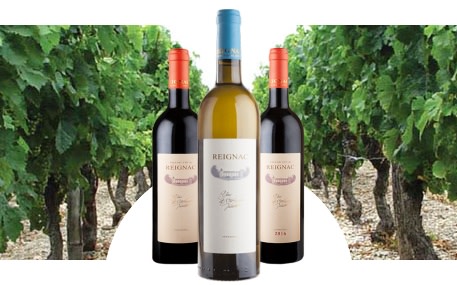
Château de Reignac is located in the Entre-Deux-Mers region, in the municipalities of St. Loubès and Montussan. Records of this vineyard date back to the 1800s. In 1990, it was purchased by Yves and Stéphanie Vatelot, who completely restructured it and expanded it to include additional vineyards.
Deeply concerned about their environmental impact, they have implemented a wine-making waste management system and cultivation techniques designed to minimize the use of pesticides.
Spotlight on an authentic Bordeaux-style " Gem ."
Bordeaux Reignac, an exceptional terroir
Located at the confluence of the Garonne and the Dordogne rivers, the Château de Reignac estate spans 145 hectares, half of which is planted with vines and the other half consists of woodlands, meadows, and wetlands. Subject to constant water fluctuations, these lands offer very distinctive terroirs that produce wines of consistent quality. There are four different soil types:• Very rich bass
• Clay loam
• Clay-limestone soils
• Very strong clays
Reignac's Red Wines
The grape varieties used are as follows:• Merlot: 65%
• Cabernet Sauvignon: 25%
• , Cabernet Franc: 10%
Reignac Red Wines
Three brands coexist:• Château Reignac: a Merlot-dominant blend. This is an entry-level wine with aromas of red fruits
• A fine wine from Reignac, established in 1996. Like a grand cru, it is produced from low yields: about 35 hectoliters per hectare, or one bottle per vine
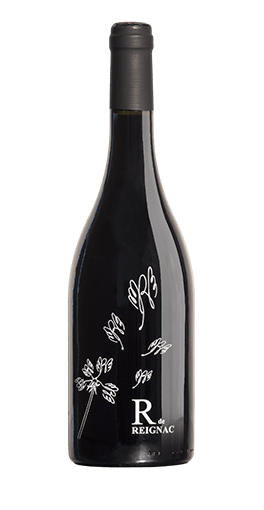
• Le Balthus was established in 2002. In 2009, Le Balthus ranked second, behind the famous Château l'Angélus, in a blind tasting organized by members of the European Grand Jury. A refined and elegant wine with aromas of dark fruit
From grape selection to winemaking
The harvest takes place in September, following a green harvest in July. The grapes are placed in a sugar bath—known as a densimetric bath—which allows for the selection of those with sufficient sugar content. They are then sorted by hand to retain only the whole grapes.Wine Making
The grapes are transferred to vats, where alcoholic fermentation begins immediately for Château de Reignac, while the other two brands undergo two maceration periods—pre- and post-fermentation. The fermentation and post-fermentation maceration of Balthus—made from the finest Merlot plots on gravel and clay soils—take place in new barrels to achieve gentler extraction and more powerful tannins. The wine is then drawn off, while the pomace is used to produce press wine.Animal Husbandry
The aging process at Château de Reignac lasts 18 months in barrels used in previous years; 12 months for the Reignac grand vin, using 45% new barrels; and 19 months (including vinification) for the Balthus, using 100% new barrels.Reignac White Wine
The vineyard planted with white grape varieties covers 3.5 hectares.The grape varieties used are as follows:
• 20% Sauvignon Gris
• , 60% Sauvignon Blanc
• , 20% Sémillon
Wine Making
Twenty-four hours after harvesting, pressing, and transfer to tanks, 80% of the must is transferred to barrels and 20% to concrete eggs and amphorae, which will impart a hint of minerality. Aging is completed in early May.Assembly
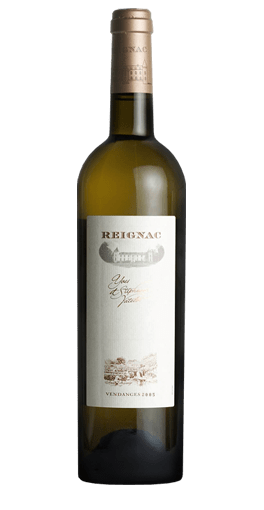
L'assemblage donne naissance à un vin blanc sec fruité, frais et minéral. Il se marie à merveille aux poissons cuits, aux fromages affinés et aux viandes blanches.Château de Reignac cultivates its vineyards with the goal of producing ripe, healthy grapes: debudding, leaf removal, and green harvesting all contribute to this. Organic inputs are adjusted according to the vineyard’s balance and the grapes’ development. At Château de Reignac, the grapes are harvested by hand, and winemaking is carried out with the utmost expertise. Thanks to the care and attention of the team, the excellence of Château de Reignac’s wine caused a sensation during the blind tasting conducted by the Grand Jury Européen at the “Les Plus Grands Bordeaux 2001” event, reminding us more than ever that the label does not always make the wine.
For more information, visit the website at Reignac
Wine estates recommended by





Buy your Reignac wines at the best price in a private sale!
Rated site21550 reviews
-20€
Starting at €99 on your first order




Loading...