Cahors

The History of Cahors Wine
It was with the arrival of the Romans in the 1st century A.D. that the first vineyards were planted in the region. Cahors wine began to enjoy some success starting in the 12th century, particularly in England, where it earned the nickname “black wine.” Subsequently, the success of these wines continued unabated, and King Francis I appreciated them so much that he attempted to have Cahors grape varieties planted in his vineyard at Fontainebleau. It was also exported to the Americas, Germany, and Russia, where it became the tsars’ favorite wine and was adopted as the wine for the Mass by the Orthodox Church. Unfortunately, the phylloxera crisis at the end of the 19th century destroyed nearly the entire vineyard. The Cahors vineyard experienced a true revival after the end of World War II, in 1947. These efforts were rewarded with the granting of the Appellation d’Origine Contrôlée (AOC) designation in 1971.
The Cahors appellation and its grape varieties
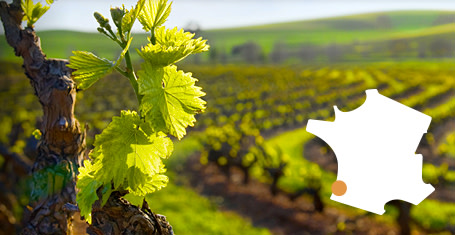
Today, the Cahors appellation covers a production area located west of the city of Cahors, straddling the Lot Valley in the department of the same name and the Causses du Quercy to the south of that valley. This production area spans 45 municipalities and covers more than 4,000 hectares, yielding approximately 150,000 hectoliters of wine per year.
Cahors wines are red wines made from three grape varieties. The primary grape variety in Cahors is Malbec, which may also be called Côt or Auxerrois. The name Malbec comes from Mr. Malbec, a winegrower who helped popularize it. And this grape variety is not found only in France; it is also very common in Argentina, where it is the most widely planted variety. Cahors wines may be made exclusively from Malbec, which is the case for the great Cahors wines. When used alone, Malbec produces wines with great structure, power, and tannins. It can also be blended with Merlot or Tannat. To qualify for the Cahors appellation, Malbec must account for at least 70% of the final blend.The Cahors Region
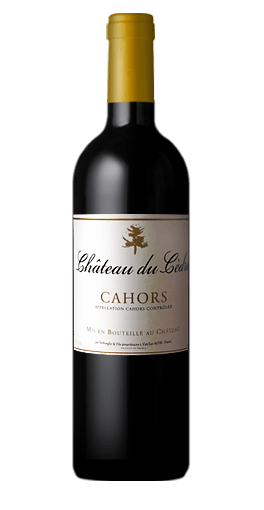
The Lot Valley, home to the Cahors vineyards, is divided into three terraces composed of alluvial deposits from the Massif Central. The higher you go, the better the soil drains. The first terraces, close to the river, produce fairly light, supple, and fruity wines that can be enjoyed young. The second terraces yield fuller-bodied wines that better meet expectations for a Cahors, with a dark color. It is recommended to wait 4 or 5 years before drinking them. It is the third terraces, along with the sandstone soils—composed of limestone scree from the Causse—that produce the densest and most tannic Cahors wines, which require a full 10 years of aging before drinking. Not to mention the high levels of the ancient Quaternary deposits—alluvial soils covering rocks that have withstood erosion: though rarer, they also yield highly renowned wines. As for the climate of Cahors, it is a blend of oceanic and Mediterranean climates. Temperatures are fairly mild, with regular rainfall throughout the year. In the summer, consistent sunshine promotes the ripening of the grapes. As for food pairings, we recommend dishes that complement full-bodied wines, such as red meat or duck stew. It can also be paired with duck foie gras, though it’s best to do so with a Cahors that has already aged for a few years. As for wineries, we particularly recommend wines from Château Haut-Monplaisir, Combel-la-Serre, and Château du Cèdre.
A Unique Winemaking Process
After harvest, the grapes are separated from their stems—a process called destemming. This is followed by a maceration period of fifteen to thirty days in tanks. This is where alcoholic fermentation takes place. During this period, the winemaker adds oxygen and yeast to promote tannin extraction. At the end of maceration, the grape pomace is pressed. This press wine may then, depending on the situation, be blended with the maceration wine. This is followed by a second fermentation, which helps reduce acidity and soften the wine. Once these successive fermentations are complete, the winemaker proceeds with blending. He will then age certain wines in barrels or tanks.The Different Appellations
An AOP wine
This red wine with Protected Designation of Origin (PDO) status is produced in a wine-growing region covering nearly 22,000 hectares and 45 municipalities, and includes approximately 350 winemakers. To qualify as PDO, wines produced in this region must contain at least 70% of the Côt N, Malbec, or Auxerrois grape varieties and no more than 30% of other grape varieties.An IGP wine
Cahors wine can also be classified as IGP (Protected Geographical Indication). This appellation encompasses approximately 230 producers—including four cooperatives—across about 600 hectares. The IGP Côtes du Lot, as it is known, offers a wider variety of wines: reds, whites, rosés, and even sparkling wines.Tasting Notes
Its deep, dark color can range from purplish to crimson. Its aromas of black fruits and spices are initially fleeting, but after four or five years, they evolve into aromas of the forest floor. When young, Cahors wine is somewhat acidic. As it ages, it becomes smoother and more full-bodied. Tannic by nature, Cahors red wine pairs particularly well with red meats, sauces, and game. It can be cellared for 3 to 10 years, depending on the vintage.Buy the best Cahors wines at a private sale!
Starting at €99 on your first order
Discover our selection of the best Cahors wine producers