
21550 customer reviews
Alsace

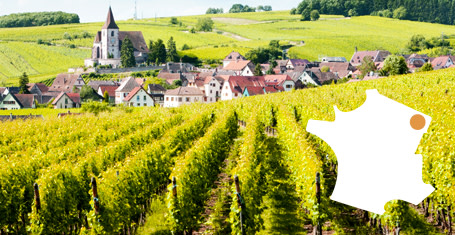
Geography of Alsace Wines and Grape Varieties
The Alsace wine region spans more than 15,000 hectares of vineyards planted on hillsides, stretching from north of Mulhouse to south of Strasbourg. Protected by the Vosges Mountains, the Alsace wine region enjoys a particularly sunny and warm semi-continental climate with little rainfall. This temperate climate makes Alsace France’s leading producer of white wines. But the region also produces renowned rosé wines, red wines, and crémants.
Most often, Alsace wines are made from a single grape variety, which gives the wine its name: Riesling, Gewürztraminer, Muscat, Sylvaner, Pinot Gris, Pinot Blanc, and Pinot Noir. These seven grape varieties have very specific characteristics and produce wines that are quite different from one another. Riesling is the most commonly used grape variety.
No fewer than 3 AOCs for Alsace wines
The Appellation d'Origine Contrôlée (AOC) regulates the production of wine within a specific geographic area to ensure that consumers are guaranteed its origin and quality.
The AOC designation for Alsace wines and Alsace Grand Cru was obtained following lengthy discussions at the national level. In 1935, an initial decree established the French AOCs, but negotiations with the INAO, the certifying body, were interrupted due to Germany’s annexation of Alsace during World War II. It was also the region’s first recognized appellation in 1962, a direct result of a vast campaign to delineate and revitalize the vineyards that began as early as 1945, thereby restoring the vineyards to their former glory.
The Alsace A.O.C. now accounts for more than 70% of Alsace’s wine production. In 2011, two geographical designations were added to the A.O.C.: “communal” and “lieux-dits.” Fifty-one exceptional “lieux-dits” have been awarded the Alsace Grands Crus A.O.C. These grands crus may be produced only from four grape varieties: Riesling, Gewürztraminer, Pinot Gris, and Muscat, with one exception: the Sylvaner Grand Cru Zotzenberg.
The label of an Alsace wine usually lists the name of the grape variety and may also include a brand name or the terms “Edelzwicker” or “Gentil” for a blend of several white grape varieties. Additional geographical indications may also appear on the label (locations, municipalities, etc.).
Alsace wines (with the exception of Crémant) are always sold in the “Rhine wine” bottle, known as the “Alsace flute,” which is reserved for them by regulation. Since 1972, they must be bottled in their region of production. Alsace Grand Cru wines account for an average annual production of nearly 45,000 hectoliters, representing just 4% of all Alsace wines. The Alsace Grand Cru appellation recognizes exceptional terroirs, which lend the wines a distinctive expressiveness and authenticity.
For sweet and dessert wines, the A.O.C. Alsace and Alsace Grand Cru designations are supplemented by the terms “vendanges tardives” or “sélection de grains nobles” for wines made from very ripe grapes. This is the case for the Gewürztraminer Zinnkoepflé Grand Cru Vendanges Tardives (Boesch wine).
Established in 1976, the Crémant d’Alsace A.O.C. recognizes the unique expertise of winemakers in producing this high-quality sparkling wine, which today accounts for one-quarter of Alsace’s wine production. Crémant d’Alsace is the second most popular A.O.C. sparkling wine consumed at home in France, after Champagne.
For several years now, many Alsatian winemakers have been committed to producing wine using organic and biodynamic farming methods (such as the wines from the Ostertag estate in Epfig, for example).
Several high-quality wineries stand out in Alsace wine production, including Domaine Paul Blanck, Domaine Bott-Geyl, and Albert Mann. Others worth mentioning are Domaine Léon Boesch and Schlumberger, Domaine Marcel Deiss, Domaine Louis Sipp, Domaine Marc Tempé, Domaine Zind-Humbrecht, and Domaine Trimbach.
Alsace wines are perfect from the aperitif through dessert
With its fine bubbles, Crémant d’Alsace—served well chilled—is the perfect way to start a delicate meal. Vegetable appetizers are brought to life with a Muscat d’Alsace. This fruity yet dry white wine pairs perfectly with asparagus and vegetarian dishes featuring cooked or raw vegetables.
For shellfish, an Alsatian Pinot Blanc is the better choice, while a Riesling or a Sylvaner pairs well with fish dishes.
Pinot Noir pairs well with red meats and game, while Pinot Gris is best served with roasts, braised meats, poultry, and offal.
No meal is complete without cheese! Pinot Gris is perfect for pairing with hard cheeses (Comté, Emmental, Gruyère, Abondance, etc.). Gewürztraminer, on the other hand, is the best match for soft cheeses (Munster, Époisses, Brie, etc.).
And to end on a sweet note, late-harvest Riesling and Gewürztraminer pair perfectly with fruit or chocolate desserts.
For more information, visit the website at Alsace
Buy the best wines from Alsace at a private sale!
Rated site21550 reviews
-20€
Starting at €99 on your first order
Discover our selection of the best Alsace wine producers
Our Latest Sales of Alsace Wines
Amélie & Charles Sparr - Muscat Grand Cru Brand Légende 2023 (Sec)
Alsace Grand Cru|White wine|Organic

More info


Amélie & Charles Sparr - Riesling Grand Cru Schoenenbourg Révélation 2023
Alsace Grand Cru|White wine|Organic
More info

Domaine Mélanie Pfister - Pinot Gris Furd 2023
Alsace|White wine|Organic
More info

Domaine Mélanie Pfister - Riesling Grand Cru Engelberg 2024
Alsace Grand Cru|White wine|Organic
More info

Domaine Mélanie Pfister - Pinot Noir Hüt 2024
Alsace|Red wine|Organic
More info

Domaine Albert Boxler - Alsace Sylvaner 2024
Alsace|White wine
More info

Albert Boxler - Gewurztraminer Brand Grand Cru 2023
Alsace Grand Cru|White wine
More info

Albert Boxler - Riesling Sommerberg Grand Cru 2024
Alsace Grand Cru|White wine
More info

Domaine Ostertag - Riesling Grand Cru Muenchberg 2023
Alsace Grand Cru|White wine|Organic
More info

Domaine Ostertag - Alsace Sylvaner Vieilles Vignes 2024
Alsace|White wine|Organic
More info


Albert Mann - Alsace Pinot Blanc W-S 2024
Alsace|White wine|Organic
More info

Albert Mann - Alsace Gewurztraminer Grand Cru Steingrubler 2023
Alsace Grand Cru|White wine|Organic
More info

Domaine Albert Mann - Pinot Noir Grand Cru Hengst Grand H rouge 2024
Alsace Grand Cru|Red wine|Organic
More info

Loading...